
Indoors, too, Jan Philip Scheibe is concerned with landscape. Here, landscape detaches itself from its geographical location and becomes a carrier of memory, perception and absence. A dead spruce from the Lemgoer Mark in a hall of the Eichenmüllerhaus, the paths of his childhood as an animated drawing, a vanished allotment hut rebuilt from roof battens. The outdoor space he examines always mirrors inner spaces as well: longings, losses. His work moves on the threshold between inside and outside, between what is materially present and what persists in the imagination.
Inside / Outside
Indoor Works
Spruce I (Lemgoer Mark)


Installation/drawing
Eichenmüllerhaus, Lemgo, 2020
Wood, metal, graphite
Dimensions variable
Jan Philip Scheibe coated a dead spruce from the Lemgoer Mark in a dense layer of graphite and draped it in the upper hall of the Eichenmüllerhaus. The tree becomes a three-dimensional drawing, its dark surface an epitaph. The work commemorates a single tree and at the same time points to the dying of a forestry culture.
LemgoTracks


Animated drawing
Eichenmüllerhaus, Lemgo, 2020
Canvas, projector
Dimensions variable
For one summer, Jan Philip Scheibe cycled and walked the routes of his childhood and youth: the way to school, the paths to friends’ houses, bike tours and rambles through woods and fields. He recorded their courses with a GPS tracker. The movements became an animated drawing. In the darkened room, the lines condense into a web.
What remains of a landscape when we return to it? LemgoTracks follows the traces of familiar paths and searches for a past that cannot be re-entered. Scheibe looks at the landscape of his childhood and wonders how his grandfather, who also grew up in this area, might have seen it. The same paths carry different times within them. With every step the landscape is drawn anew, overlaid by memory and altered by the present gaze.
Vogelsang


Installation
Eichenmüllerhaus, Lemgo, 2020
Wood, metal, framed postcard, shards of coloured light bulbs
265 × 202 × 255 cm
Jan Philip Scheibe reconstructed his family’s allotment hut from roof battens as a three-dimensional drawing. The family gave up the garden in the early 1980s, and the hut disappeared soon after.
The vanished place lives on as memory and imaginary space. From the lines of the battens rises the framework of a lost world. Vogelsang gives this inner image a spatial form, without being able to bring back what was lost.
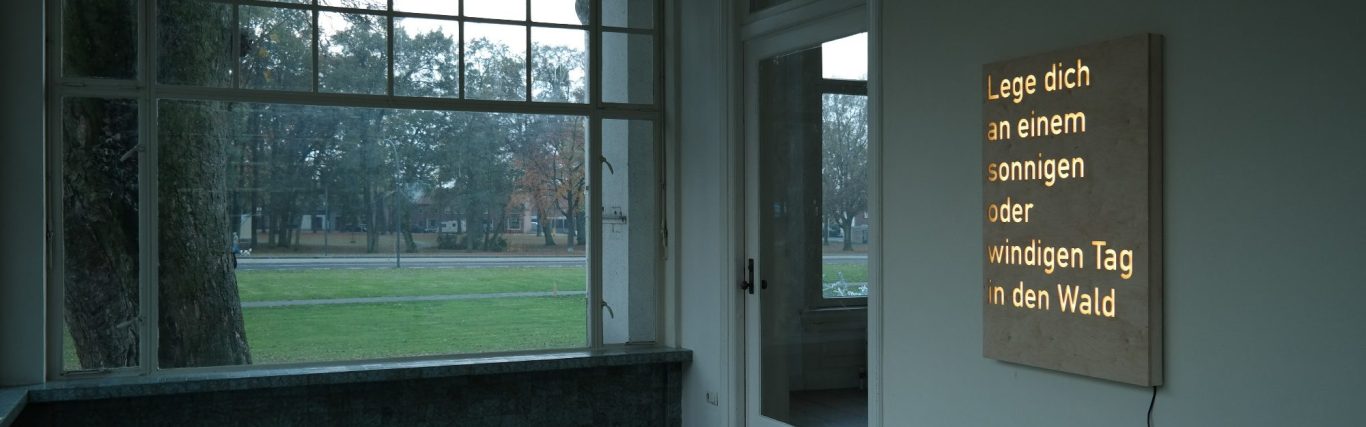
Lege dich (Lie Down)


Light object
Villa de Bank, Enschede, the Netherlands, 2016
Quotation: Robert Musil
Wood, cast resin, LED lighting, cables
118 × 82 × 6 cm
“Lie down in the forest on a sunny or windy day.” The quotation from Robert Musil describes an attitude familiar to Jan Philip Scheibe. The forest is a supposed counter-space to society, a place where one must fit in and assert oneself differently.
Lege dich speaks of the feeling of being held. And of a place that is itself under threat. The forest is not an untouched retreat. Worldwide, it is under pressure from economic interests that turn it into a resource.
kiddyridefun


Object
Villa de Bank, Enschede, the Netherlands, 2016
Fibreglass, electronics, metal, plastics, control unit
Dimensions variable
A coin-operated kiddie ride, the kind found in shopping centres: flashing lights, coloured lamps, the promise of a ride to happiness. In the Villa de Bank it has driven into a wall. What remains is major bodywork damage and scattered car parts.
kiddyridefun tells of the collision between childhood dreams and reality. Of the ideas with which we set out in life, and the crashes that sober us over the years.
ruhelos (restless)


Word/light installation
Institute of Art History, University of Bonn, 2009
Wood, paint, plastics, lighting, cables, programme · 320 × 80 × 15 cm
At the entrance to the library of the Institute of Art History at the University of Bonn, the letters RUHELOS (“restless”) flash like a funfair, incessantly. The word is set in motion and becomes an emblem of a time that hardly stands still.
Between social media, constant availability and omnipresent noise, calm becomes a rare state. The light does not stop flashing.
Laternen liegen (Street Lamps Lying Down)


Installation
Aula Carolina, Aachen, 2003
Metal, plastics, film, lighting, cables
Dimensions variable
Thirteen street lamps from the Aachen highways department lie on the floor of the Aula Carolina. Their six-metre poles form a web of lines, the bulbs covered with blue film. The lamps keep glowing even though they have left their place in the street.
What normally stands upright and gives orientation now lies still. The blue light turns these everyday objects into a quiet, almost floating landscape.