
Jan Philip Scheibe walks. In his performances he moves through landscapes that people use, change and consume: city and industry, nature and tourism, familiar places and distant holiday destinations.
He carries light and everyday things into them: plastic bags, funfair signs, an inflatable swan. Sometimes these things seem absurd, sometimes unsettling, sometimes almost natural. They shift the view of a place and make visible what is otherwise easily overlooked.
Many works also tell of the loss of familiar landscapes and of the experience of one’s own surroundings changing. The Australian philosopher Glenn Albrecht coined the term solastalgia for the distress caused by such change.
Scheibe’s means are simple: walking, light and an unexpected action. A man carries something through the landscape. And suddenly the place he walks through appears in a different light.
Walking
Performances
Mountain Hike to Satsfjäll (Fjällvandring till Satsfjäll)


Walking act
Cardboard, film, LED, control unit, cables
Saxnäs, Sweden, 2021
Photos: Swaantje Güntzel
The day before the performance, Jan Philip Scheibe photographs the silhouette of Satsfjäll, a striking mountain near Saxnäs. Using it as a template, he builds a three-dimensional, illuminated body that he wears on shoulder straps.
At sunset Scheibe walks through Saxnäs, past the village school and shop, along gravel roads, beside wild streams and waterfalls. Through the blue hour and into darkness he walks to the spot from which he photographed the mountain. Three or four people accompany him for part of the way.
The walk leads from the village into a vast, rugged landscape in which forests, mountains and rivers largely follow their own laws. Satsfjäll stands for this landscape as a whole. Scheibe carries its image through it and brings the mountain to the mountain.
Norrsken över Kultsjön (Northern Lights over Lake Kultsjön)


Walking act
Cardboard, film, LED, control unit, cables
Saxnäs, Sweden, 2021
Photos: Swaantje Güntzel
The northern lights were once the subject of myth and veneration, a secret in the sky. Today they are part of the tourism industry: planeloads of travellers are flown to northern Sweden, Finland, the Lofoten Islands and Iceland to see them. In parts of Asia they are regarded as a symbol of good fortune. Instagram and TikTok have further fuelled the aurora mania.
Much is lost in the process. The aurora is usually faint and asks for patience, observation, a willingness to engage. AI-assisted phone photography, by contrast, makes it glow strongly, in pictures that have little to do with what the eye sees. The look at the display replaces the look at the sky. Landscape becomes a backdrop for one’s own staging.
Jan Philip Scheibe builds a backlit light box, which he carries in front of him like a photo backdrop. Wherever he walks, people can stop and have their picture taken in an artificial aurora. A portable northern lights generator.
Kiddy Ride fun


Performance
Lemgo, 2020
Photos: Swaantje Güntzel
Jan Philip Scheibe takes the ride-on car with its dented bodywork out of the white cube and brings it back onto the street. In his home town of Lemgo, he tows it in a suit through the pedestrian zone. He plugs it into a socket, squeezes himself into the child’s car and, his pockets full of 50-cent coins, feeds it coin after coin. For an hour he lets himself be shaken about.
The unannounced performance puzzles passers-by. Some stop and later seek out a conversation.
Kiddy Ride is about the distance between childhood dreams and adult reality. What became of the promises a generation grew up with? Did they come true, or has life turned out more complicated? And what do young people dream of today?
Sorrow and Solitude (Leid + Einsamkeit)


Walking act / Performance
Funfair light sign, hand cart
Blomberg-Reelkirchen, 2020 (Long Night of Light Art) · Detmold, 2021 (BILDSTÖRUNG kompakt)
Photos: Swaantje Güntzel
The funfair light sign Leid und Einsamkeit was made in 2016 for an exhibition at Villa de Bank in Enschede, the Netherlands. During the Covid-19 pandemic, Jan Philip Scheibe takes the work out of storage, mounts it on a hand cart and pulls it through Blomberg-Reelkirchen during the Long Night of Light Art.
The pandemic shows how vulnerable coexistence is and how much care and solidarity are needed in times of crisis. With its illuminated lettering, the performance becomes a mobile memorial to people who experience suffering and loneliness.
Waldi


Walking act / Performative intervention
Cardboard, film, LEDs, battery, broomstick
Hamburg-Ottensen, 2019
Photos: Swaantje Güntzel
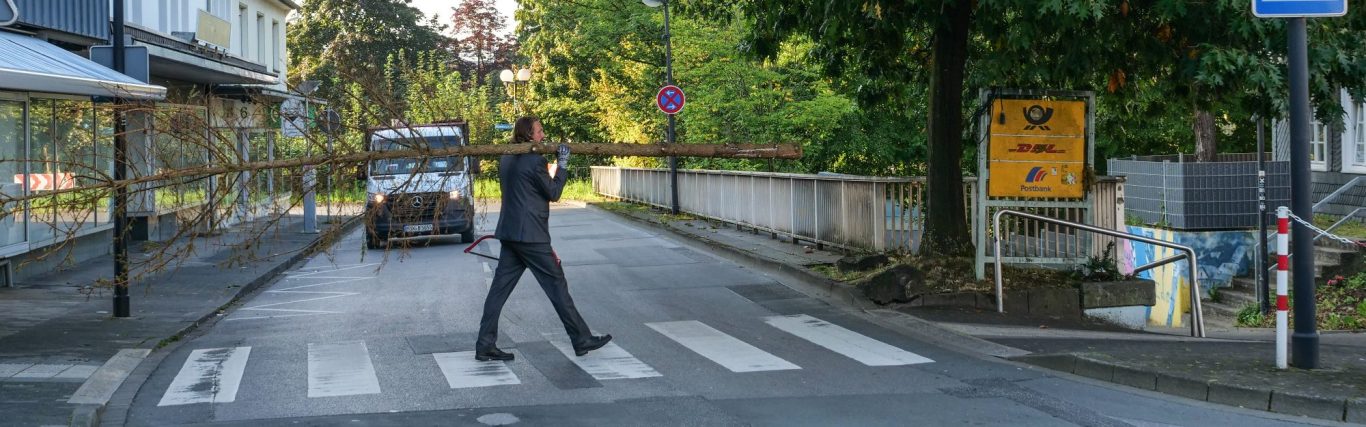
On a rainy Sunday, Jan Philip Scheibe builds an illuminated W. The following day he attaches it to a broomstick and carries it from his flat to the nearby Aldi. There he holds the W in front of the illuminated Aldi sign. Aldi becomes Waldi, a classic German name for a dog, above all for a dachshund. Soon the store manager comes out and asks him to leave.
This small shift of the brand name becomes an occasion to ask who public space belongs to and who decides which signs may be visible there. Passers-by stop and start talking to him. A single letter becomes an intervention that briefly knocks the commercial everyday out of rhythm.
Plastic Bottles (Plastikflaschen)


Performative intervention
Plastic bottles, lighting
Scheibe & Güntzel
Costa Teguise, Lanzarote, Spain, 2018
Photos: Stefan Nimmesgern
Plastic stands for a throwaway society: it produces a durable material for short-lived consumption and often leaves its disposal to ecosystems.
The day before the performance, Scheibe & Güntzel collect plastic bottles on a stretch of coast outside the tourist resort of Costa Teguise. A great deal of plastic waste lies between rocks and cliffs.
They make the bottles glow and carry them through Costa Teguise on a night of full moon. The town stands for a tourism culture of standardised offerings that look alike the world over and have little to do with their surroundings. The glowing bottles carry the traces of the throwaway society back to the place of consumption.
The Swan (Der Schwan)


Walking act / Performance
Inflatable plastic swan, LEDs, battery
Scheibe & Güntzel
Lanzarote, Spain, 2018 · Hamburg-Ottensen, 2018
Photos: Swaantje Güntzel
The inflatable swan is a familiar companion in holiday regions the world over. As a pool float it stands for holidays, leisure and consumer culture. For Plastisphere, a project by Scheibe & Güntzel, Jan Philip Scheibe turns such a swan into a glowing figure in 2018. Fitted with LEDs, he carries it through the landscape of Lanzarote.
The same year he continues the performance in Hamburg-Ottensen. On a mild summer night he walks through the district in a suit with the swan. A small, silent opera in public space emerges. Among the revellers, the man with the glowing swan looks like an unexpected apparition. The performance interrupts the familiar perception of urban space and turns everyday paths into a quiet, absurd staging.
Plastic Bag Man (Plastiktütenmann)


Walking act
Plastic bags, lighting
Scheibe & Güntzel
Saxnäs, Sweden, 2017 · Bentlage, 2017 · Leeuwarden, the Netherlands, 2018 · Lemgo, 2020
Photos: Swaantje Güntzel
The Plastic Bag Man was created in Saxnäs in 2017 as part of Preserved, a project by Scheibe & Güntzel. Its starting point is the question of how people survived the extreme conditions of northern Sweden and how they opened up the landscape for themselves.
Historic trade routes ran between northern Sweden and the Norwegian coast. Goods, including furs, had to be carried on foot through the hard-to-access fjell, often at risk of their lives.
Scheibe & Güntzel take up this trade route and translate it into the present. Scheibe crosses the frozen Lake Kultsjön carrying two illuminated Aldi plastic bags. The laboriously transported goods are replaced by symbols of a globalised consumer society. What once meant exertion and mortal danger is now taken for granted as readily available. The performance asks how our relationship to goods and their transport has changed.
Further performances: at the light festival at Kloster Bentlage, at the LUNA light festival in Leeuwarden and, in 2020, in Scheibe’s home town of Lemgo.
Maize (Mais)


Walking act / Performative intervention
Plastics, metal, cables, lighting
Münsterland (German-Dutch border region), 2013 · Oderwitz, 2021
Photos: Swaantje Güntzel
Maize cultivation has changed the cultural landscape within a few decades. Where fields of different crops, meadows and pastures once shaped the landscape, maize monocultures now stretch across many areas. The maize becomes biogas, animal feed and, through it, meat.
For the project Grenswerte in the German-Dutch border region, Jan Philip Scheibe builds three stylised maize plants in 2013, each five metres tall. Fitted with blinking diamond-shaped light caps of the kind known from funfairs, they become oversized, unsettling signs in the landscape.
Scheibe travels through the border region with the plants and visits places where the consequences of maize cultivation become visible: a biogas plant, a cattle fattening farm, extensive maize fields. Sometimes he sets up all three plants, sometimes he pulls one along on a hand cart. On the way he talks with people about maize cultivation, the changing landscape and what this change means for them.
In 2021 Scheibe takes up the work again at the art festival “Mit Nachbarn” in Oderwitz, a small town in Saxony. He walks through the town, which is under similar pressure of change and is enclosed by ever taller maize fields.